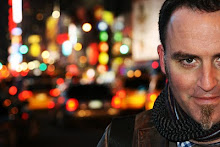
Fiona is here tonight, and we've just been up to the village, we hoped, to eat at Cafe Rouge, but it was closing early, so we went next door to Strada where we ate lovely food. Mushroom bruschetta? Not 'arf!
It's Eurovision week, so gay men across the world have stopped answering their emails and have gone into party mode. My brother and Sascha are out there in Stockholm, and we're hosting three parties for the two semi-finals and the final.
In the meantime I have a load of admin to do. More forms to fill in. More pots of money to identify and chase. Tomorrow we're cutting together a little video of the cast of Brass begging the BBC to allow us to perform the work in a site-specific Northern location later in the year.
I've also been composing, and finally have started to get my head around my composition for the London Gay Men's Chorus' "Shame" initiative.
I went to the gym just after lunch. It's been incredibly hot and muggy today which means I am permanently in a state of melting. I finished my work out, had a shower and literally couldn't dry myself. I even tried using a hair dryer to dry my body, but the sweat just kept on dripping. Quite extraordinary.
I also realise that I've been bitten by gnats, probably whilst Nathan and I lay in the parakeet field last night looking at a cloud formation which resembled Virginia Wolf and then morphed into the shape of a skull, which was, well, a little disconcerting. So disconcerting, in fact, that we plainly didn't notice we were being munched on.
I have started using Pritt Stick on the ends of my moustache! I was quite horrified yesterday to discover the handlebar sagging and looking like the legs of a tarantula, so I went online to see if I could find any suggestions. One guy seemed to spend hours primping his moustache with a home made cardboard invention and a load of hairspray, but someone else just suggested daubing the ends with Pritt Stick and wrapping them around a simple pencil for the curl. I did it. It worked. And it held all day!
It rained in the late afternoon. The sky went a very odd murky colour and, by seven o'clock I had to turn the lamps on in the sitting room. When Fiona arrived, and we walked up into the village there was a glorious smell in the air: a smell which was more than a little reminiscent of my childhood... It was a heady, rich, verdant sort of smell. The aroma of rain on a summer's day. The smell of hedgerows filled with cow's parsley, stinging nettles, dock leaves and cuckoo spit. You don't often get this smell in Highgate and I enjoyed every moment!
We spent the last hour of the day watching the section finals of the BBC Young Musician of the Year which boasted not one but two of the players from this year's Brass pit orchestra. Both Stephanie and Zach played astoundingly well. I felt proud to be associated with them and very excited to think that they'll be playing my music in the summer.
Tuesday, 10 May 2016


Sunday, 8 May 2016
Rescuing the bee
I spent a morning doing bits of admin before our attention was drawn to a sad-looking bee whom I found exhausted and sitting on the window ledge in the bathroom.
I can't bear to watch a bee in trouble, so I rushed to the kitchen and found some honey which I put in a little pile next to her. She immediately started to eat it, but ended up with her face stuck in it, so I was forced to repeatedly rescue her with the aid of a little comb. She then kept rolling over and getting stuck on her back which was really very distressing to watch. The poor thing was plainly at death's door.
We decided to leave her whilst we had our breakfast, and when we returned, she was looking perkier, but when she tried to fly, she merely dropped onto the floor. So out came the honey again and this time she seemed entirely content to actually feed from our fingers whilst sitting on our hand. She started to clean herself at this point which we took to be a good sign.
Ten minutes later, we opened the window, and a little later, she flew away happily. Bee officially rescued.
This afternoon I met young Ben from the cast of Brass at Hampstead Tube. It was the perfect day to visit the Heath: absolutely boiling, 27 degrees. Hotter than Italy. Hotter than LA. The Heath was rammed. The roads around the edge were gridlocked, and finding a parking space was almost impossible.
But something happens to London when it gets hot - particularly when it's a weekend. Everyone slows down a bit. Everything takes on a happy, hazy atmosphere. For some reason on days like this I always think about Adele's Hometown Glory:
"I like it in the city when the air is so thick and opaque. I like to see everybody in short skirts, shorts and shades."
I took Ben on a tour of all my favourite parts of the western side of the Heath. We walked up Heath Street to Jack Straw's Castle and beyond to the pergola which was, as ever, looking like the set of a Shakespearian play.
We crossed the road and wandered around Sandy Heath for a while before heading to the tree with the hole in it, which we sat inside for a while.
I think Ben was particularly impressed by the Vale of Health, that curious little encampment of wisteria-covered Edwardian houses in the middle of the Heath where the only sounds you can hear are the chirping of birds. It's where DH Lawrence and the Bengali poet Tagore once lived. It's also the home of a permanent gypsy encampment which seems to co-exist quite happily with, what has become, one of the most desirable set of residences in London, if not the world. I always have the somewhat romantic notion that both communities look out for one another.
We ended the afternoon back in Hampstead Village where we ate an apple pie and a cheese cake.
As I returned to the car, I noticed that the sun had started to cast rather beautiful shadows, so telephoned Nathan, told him to stand by, rushed to Tesco in Highgate Village (which had literally been stripped of food by a locust plague of picnickers and revellers) bought a few bits and bobs to snack on, collected Nathan from the house, and took him back to the Heath where we sat, on a rug, in the parakeet field, until the sun went down.
The day ended in front of Masterchef whilst orders for Nathan's latest sock "recipe" buzzed into his phone. The right person won Masterchef. And the right people are buying Nathan's design.
Heathy
I went to the Heath in the late afternoon today to meet my old chum Ted, his girlfriend, Gersende, and her lovely friend, whose name I've forgotten because it was French and a little unpronounceable! How awful and English does that make me?
We had a lovely time. Gersende and I walked across the middle of the Heath looking for Ted and the lovely French lady, but when we reached the other side, we discovered they were back at the exact place where we'd started!
They're still digging up the ponds. The place looks like a horrible mess, with great big steel fences and piles of brown mud lining pretty much any water source. I think they're creating drainage solutions in the very unlikely event that a catastrophic rainstorm, focussed on the Heath, leads to the ponds bursting their banks.
As unlikely as it seems, there was a major weather event in 1975 which caused all the streets in Gospel Oak, Southend Green and the Vale of Health to flood rather terribly. You can hear all about it the next time the Fleet Singers perform Songs About The Weather! The flooding was so bad that people were said to have drowned in their basement flats! They said then that the likelihood of it happening again was, like, a million to one, but the UK climate is changing so I suppose they're taking no risks.
It was lovely to catch up with Ted, and I've become a massive fan of his Mrs to the extent that when she pulled out a bottle of champagne from her back pack I was really hoping it was going to be followed by a lovely little announcement. It wasn't. Apparently we were simply toasting the sunshine. I'd have been happy to toast the fact that Gersende had cycled all the way up to the Heath from Dulwich in just an hour!
The Heath looked glorious in the evening sunlight. It was packed full of revellers, many of whom seemed to be smoking dope! Huge wafts of the stuff were floating over us as we sat by the boating lake watching the sun going down.
We walked up to Highgate in the evening for a drink in a pub. The famous Flask was ram-packed, so we went to the one which sells Thai food and backs onto Pond Square, which Ted and the girls absolutely loved. I forget sometimes quite how special Highgate is... Sadly, none of us saw the ghost of the frozen chicken which is said to haunt those parts. That's right: the ghost of a frozen chicken!
Saturday, 7 May 2016
The Midlands spirit?
I had an interesting email exchange today with a BBC staff member from Nottinghamshire who claims that Midlanders are not unified by a sense of belonging. More specifically, he says that people in Nottingham have no interest in what's happening in Birmingham and that Derby residents aren't bothered about hearing the news from Staffordshire and so on. He doesn't believe that the Midlands, as a single entity, actually exists. He says the people who live in his corner of Nottingham are much more interested in places like Sheffield and Leeds. I was quite surprised by his comments. In fairness, he does live in the North of Nottinghamshire, north of the River Trent, which, I discovered whilst making A1 The Road Musical, is generally the point at which Midlanders suddenly start calling themselves Northerners, but I still maintain that Midlanders, true Midlanders, have a strong sense of kinship.
What unites us is undeniably intangible. I guess we all know how it feels to live miles from the sea in locations that people are usually passing through. I think, as a result of this, that Midlanders can have a somewhat inward-looking stance which has a fairly catastrophic effect on self-esteem. I have discussed this in several previous blogs, so shan't enter this particular verbal cul-de-sac here.
The media doesn't encourage any of us to label ourselves as Midlanders or feel any pride in our Midlands heritage. It seems that they want everyone to be either northern or southern. To entertain anything else would mean that the world can't be painted in clichéd shades of black and white. The BBC, for example, has a large pot of funds which it dedicates to projects which celebrate "the north" (whatever that is.) Senior BBC figures whom I've spoken to about the Midlands identity have all felt the need to talk about the Asian community in Birmingham as somehow representative of the Midlands. I often feel they think everything else that goes on in the area is bland and vanilla. No wonder we struggle to find our identity.
I called my parents at lunch time to see if they could throw any light on the matter. My Dad feels the East Midlanders care more about their rugby than those in the West and that the north-south-biased transport networks in the UK have traditionally prevented Midlanders from exploring their own region.
And yet, despite all this, I continue to feel a great affinity with all Midlanders whether they're from Brum, Cov, Newton-In-the-Willows, Clun or Corby. I have even grown to accept Derbyshire as part of the gang! As a lad, I didn't used to feel I had a great understanding of Derbyshire, which always seemed an other-worldly sort of place, covered in hills and snow and really only the place where Simon Groome and Goldie used to go tobogganing.
I wonder if I maybe place too much emphasis on searching for my tribe? Perhaps it's because I've lived all over: born in Shropshire, grew up in Northants with ancestors in Leicestershire, Warwickshire, Birmingham and Staffordshire. To an outsider, they may seem like disparate, somewhat random places, but they're all in the Midlands. My family have stayed within the confines of this geographical area, never moving south or north (apart from the Welshies!) I feel very proud to be the grandson of a man who ran a soup kitchen during the Coventry blitz and I think Midlanders will have more of an idea of the significance of this statement. When I go to the Midlands, I see names that I recognise on gravestones and hear speech patterns and inflections that make me feel comforted. These feelings are too powerful to ignore.
Any thoughts from Midlanders on this issue would be interesting. Do I simply need to acknowledge that the Midlands doesn't exist and move on? Or is it okay to cling to a romantic ideal that all Midlanders have something inexplicable in common?
Thursday, 5 May 2016
Join the Kew
What a lovely day! We've been in Kew Gardens with my parents all afternoon curtesy of Daryl who gave us some tickets which I was able to give to the parents at Christmas. The weather couldn't have been more perfect: a hot bright sun, a dark blue sky, and a gloriously refreshing breeze accompanied us all day.
We met the parents at Highbury and Islington after voting in the mayor election (both of us opting for the same, somewhat illogical combination of Labour and Lib Dem), putting the car into the garage to be patched-up, and buying some lovely picnic things.
We took the overland train from Highbury to Kew Gardens through all those rather romantic-sounding stations like Hampstead Heath and Finchley Road and Frognal. The railway line cuts through a swathe of greenery. London is so leafy. People who live outside the city are often rather shocked to discover this particular fact.
The area around Kew train station is very special. It's hardly surprising that houses in that neck of the woods sell way into the millions. There are all sorts of lovely little shops and the roads to the gardens are lined with stunningly well-maintained trees.
Kew Gardens itself is a very special place, particularly at this time of year. The star attraction is almost certainly the bluebell wood around Queen Charlotte's Cottage. It's the most extraordinary sight: a blanket of blue and purple underneath old English Oak trees stretching as far as the eye could see. In the shade, the delicate flowers are the darkest indigo, but in the sun, they glow brilliant shades of lavender and lilac.
The smell is intense. British bluebells have a similar aroma to hyacinths, and I learned today that they're actually known as wild hyacinth or "hyacinth non scripta." At one point the smell became almost overpowering when it merged with the aroma of wild garlic.
The birds were plainly very happy to be alive in Kew today. They were singing almost constantly, and, at one point, we were joined by a lovely little robin who wanted to sing to us for a while from a branch just above my head.
We sat and watched the ducks, geese, coots and swans on a bench by the lake for some time. Several of the ducks seemed to be gay. One couple - both male - seemed very attached to one another. Then they started mating! I didn't know where to look!
We crossed the bridge to get away from a swan who seemed intent on puffing itself up to a great height to intimidate us. As we made a hasty exit, we passed a bloke with a broken arm, "been this way already have you?"
We had our picnic down by the Thames with the glorious Syon House positively glowing on the other side of the water. My Mum had neatly cut out a newspaper article about the Battle of the Somme to show me. It came in the form of two pieces of paper, perhaps twenty centimetres square. At one moment a crazy wind blew-up which literally took the pieces of paper out of my hand, instantly carrying them high into the air. At the same point, a vortex of dust rose high from the path beside the river. The pieces of newspaper rose higher and higher - like a pair of helium balloons - perhaps forty feet into the air, right across the river and into the woodland in front of Syon House. How bizarre is that?! We wondered if we'd just witnessed one of the infamous Thames corridor tornadoes. When I say infamous, I mean totally unheard of, despite the fact that the Thames corridor actually experiences more tornadoes than anywhere else in the world. They're just not at all powerful. Or interesting!
We walked back to the main gate and drank cups of tea in the main cafe, before buying lollipops and heading back to Highbury where we went our separate ways.
Wednesday, 4 May 2016
Ghastly man
I had the most horrifying conversation this morning with someone on the switchboard of the National Maritime Museum in Greenwich. I basically phoned, at the suggestion of one of my contacts in the museums industry, to find out who it was best to speak to about a potential installation. I explained who I was, and said I was simply looking for an email address where I could send my pitch. The man who answered the phone was rude and essentially did his best to make me feel like a worm who'd just crawled out of a compost heap. "As you're a cold caller" he said proudly, "I'm not allowed to give you a name." I asked if I could maybe email him and get him to pass the email on to someone more appropriate. "Your only option is to send a letter or a fax." He said. A fax?! A flipping fax?!! I sighed, resigned, "okay, who should I be addressing this letter to?" "As I've said," he said, "I'm not permitted to give you a name." "Can I ask what YOUR name is?" I asked "I don't have to provide you with that information..." And that was that. "Thank you for being so unhelpful," I said. And hung up.
I felt incensed and then ashamed and then incredibly depressed. It's difficult enough to cut a living in the arts without bastards like that doing their best to make you feel like third class citizens. I have a pathological hatred of making phone calls at the best of times so always appreciate it when people have the decency to make me feel like my phone call actually matters. Surely the best way to deal with answering telephones is to assume that everyone who rings in is a human being, who hasn't deliberately called to make your life a misery! As Ru Paul says, "stop! And ask yourself a question: do I want to be right... Or happy?"
I tweeted my disgust at the museum and then contacted their press office for a quote for this blog, which wasn't forthcoming, but they did get straight back to me, and diverted my complaint to the man who deals with such matters, who, I have to say, has been incredibly efficient and sympathetic: "We do not have a ‘no names’ policy and nor could/should we as a public service! I shall ascertain what has happened..."
I feel slightly vindicated, although I still find myself hating the fact that, to get anything fun off the ground, you have to deal with heaps and heaps of this sort of nonsense.
I now have a little curly moustache which I'm training with the aid of a bit of special wax. I think having weird facial hair is a bit like driving a Morris Minor. You end up locking eyes with the other men you pass who are equally sartorial in the moustache department. I get the impression that it's a bit of a club, but that those with longer, curlier moustaches look down on those like me with shorter ones. That's my perception anyway. I'm wondering if I look a bit ludicrous, but am hoping that the key to not looking too much like a fuddy-duddy Dali is maintaining stubble over the rest of my face. I may, of course, be entirely wrong.
We went to an event this evening hosted by the Arts Department of Channel 4, who, of course, commissioned our wedding. Grayson Perry (who beat us in most of the awards we were nominated for) was launching his new show about masculinity, and it looks absolutely fabulous. He's such a talented man.
We walked across Trafalgar Square in the lengthening shadows of the early evening sunlight. It was a genuine treat to be out and about. What lovely weather we're having this week!
St Bride's
I woke up this morning to the news that Leicester City had won the Premiership. It made me think a few things. Firstly, that my Dad, a life-long Leicester City fan, will be over the moon, and secondly, that footballers are paid far too much money. I assume that the Leicester City players are some of the least expensive in the Premiership, and that their success can be put down to the fact that they simply played well as a team. Football is, after all, a team game. It's always stuck me that these preening, prancing, goal-hanging, ludicrously expensive "top flight" players, are often in it for their own self-glory. The England side are routinely thrashed in the World Cup by teams which, on paper, oughtn't to be able to hold a candle to us. I have long thought that our pitiful record on a national level was due to "star" players lazily resting on their puffed-up laurels. Create an English team out of second division players, make them train together three times a week and I bet the strategies they'd develop would thrash our "A" team in seconds.
But, I'm no football pundit. I used to run in the opposite direction when the sweaters were thrown down on the school field - unless, of course, they were being used as rounders posts. I was always accused of toe-punting (whatever that means) and stupidly amused by the kids shouting "handball" because I thought they were referencing Hamble, the ugly doll off of Play School! The girls had way more fun at playtime. Their games were far more imaginative. They plaited hair and span in circles to see how far their dresses billowed out...
This afternoon I visited two churches where I'm hoping to create a little installation in September. I'm not going to say too much about the idea at this point for fear of jinxing it, but it involves television screens and a crypt!
The highlight of my day was undoubtedly a tour around St Bride's Church, which has to be one of the most fascinating churches I've ever visited. I was greeted by the vicar and an administrator, both absolutely charming women, the latter of whom had been in the choruses of the Raymond Gubbay operas I worked on at the Albert Hall in the late 90s. We had a good laugh exchanging stories. The Aïda was a particularly bizarre production, one which seemed to engender slightly odd behaviour from those who had the misfortune of being involved. On the last night of the show, for example, a fair number of the female chorus were thrown into the onstage pond as the lights went down. I still remember the piercing operatic screams echoing in the darkness!
Anyway, St Bride's is the church where Pepys was baptised. In fact, he was born in a building right next to the place. His brother was buried there, as were a number of his siblings who died in infancy. The church burned down in the Great Fire of London and was bombed out in the Blitz. There's a little museum in the crypt which has some charred wooden remains from 1666 alongside a little pile of warped and semi-melted pieces of stained glass.
St Bride's is on Fleet Street, and is known as the cathedral of the newspaper industry. Its famous, gleaming white, "tiered" spire was the inspiration for the first ever wedding cake. And that's a fact!
The crypt has a tiled Roman pavement running through it and all sorts of foundation walls from various periods. There's been some kind of church on the site since the 6th century. The original church was probably founded by nuns. We know this, apparently, because of its name.
I was taken through a locked door and introduced to the charnel house, which was incredibly eerie. I didn't actually know what a charnel house was, but it turns out it's essentially a storeroom for human remains which are removed from crypts when they become over-crowded. The coffins which take up most of the room in these scenarios (particularly when they're made of metal and lead to ward off body snatchers), are disposed of, and the larger human bones, mostly femurs and skulls, are neatly stacked in the charnel. The bones I was looking at today were medieval. It was an incredibly thought-provoking experience. All of those people had relatives and friends that grieved their passing, and yet we have no way of ever knowing who they were. Some 7000 bodies were buried on the site throughout history, a particularly obscene number of those during the cholera epidemic.
St Bride's is most unusual, however, in the fact that all 227 people who were buried under the nave, and whose bodies were disturbed when the church was bombed in the war, have been carefully catalogued and stored in boxes in the crypt for research purposes. You take a box from a shelf which, for example, might be labelled "skull," open a little book and find out that said skull belonged to a bloke called John something or other who lived at such and such address and drowned in the Thames at the age of 27. It's a remarkable resource. And what makes it even better is that the vicar understands the importance of her church, not just spiritually but socially and historically. She's a live wire who's so into historical research that she says she finds it a little odd to work in a church with no parish records to speak of. The two catastrophic fires destroyed anything of that nature. In her previous church she had great fun digging out records - particularly before weddings - so she could tell the happy couple about those who'd shared their wedding anniversary in the distant past. Christmas Day, I believe, was a very popular day on which to get married in those days. Pepys was thrilled on Christmas Day 1665 that a couple were getting married in his parish because it indicated that the long, dark days of the plague were well-and-truly over:
"To church in the morning, and there saw a wedding, which I have not seen many a day; and the young people so merry one with another, and strange to see what delight we married people have to see these poor fools decoyed into our condition, every man and woman gazing and smiling at them."
Subscribe to:
Posts (Atom)